A Recap of the Atlanta Beltline Transit Study
The plan coordinates the individual needs of each Beltline area while considering the larger system
- Transit
- Community Meetings

On September 3, Atlanta Beltline hosted a Citywide Conversation to present final recommendations and next steps for the Beltline Transit Study (BTS). Funded by the Federal Transit Administration, the three-and-a-half-year study consolidates years of prior work into a holistic plan for high-capacity light rail transit along the Beltline corridor.
Given MARTA's planning work in the Northeast Beltline Quadrant, the BTS focused on the northwest, southwest, and southeast quadrants of the Beltline. The study identified preferred routes and stations within the transit corridor that will improve regional connectivity and ensure equitable transportation options for all. Initial findings were presented to the public for feedback and input during a public meeting in 2024. Following that meeting, the team continued public engagement, developed service plan assumptions, created ridership projections, and developed cost estimates.
A northwest transit path identified
Three alignments for transit in the northwest quadrant remained under consideration during the final stages of the study: CSX, Peachtree, and Ottley. Each alignment offered a series of benefits and challenges. Ultimately, the team has recommended the CSX alignment as the locally preferred alignment alternative. This alignment will ensure the fastest average speed and lowest travel time, direct service to Piedmont Hospital, lowest capital cost, and highest ridership.
Southwest and Southeast transit stops
While the initial study explored all possible transit stop locations, the final station recommendations include the following stations:
Donald Lee Hollowell Pwky.
Joseph E. Boone Blvd.
Martin Luther King Jr. Dr.
Langhorn/Enota
Ralph David Abernathy Blvd.
Lawton St.
Murphy Ave.
Metropolitan/Pittsburgh Yards
Pryor Rd.
Milton Ave./Hank Aaron Dr.
Hill St.
Boulevard
Glenwood Ave.
Service Plan, Ridership & Cost Estimates
Final recommendations include three routes with bi-directional service, running 18.5 hours a day (6:00 a.m. to 12:30 a.m.). This includes a Beltline Loop, running the entirety of the Beltline, as well as a Northern Loop and a Southern Loop that provide service into Downtown Atlanta. Each route would have 20-minute headways, resulting in 10-minute headways at platforms. The plan provides for a one-seat ride anywhere in the system, as well as MARTA heavy rail infill stations.
The team used the Federal Transit Administration’s “Simplified Trips-on-Project” Software (STOPS) to create ridership models. The outputs conservatively project 4,200,000 annual riders. This includes an estimated 40% of transit dependent riders, 55% at infill stations, and 21% new transit trips.
Finally, the projected capital cost estimates for the proposed three-route light-rail system amount to $3.5 billion as of 2025. This capital cost is based on quantities from a 10-20% design vs. a cost per mile.
Make Your Voice Heard
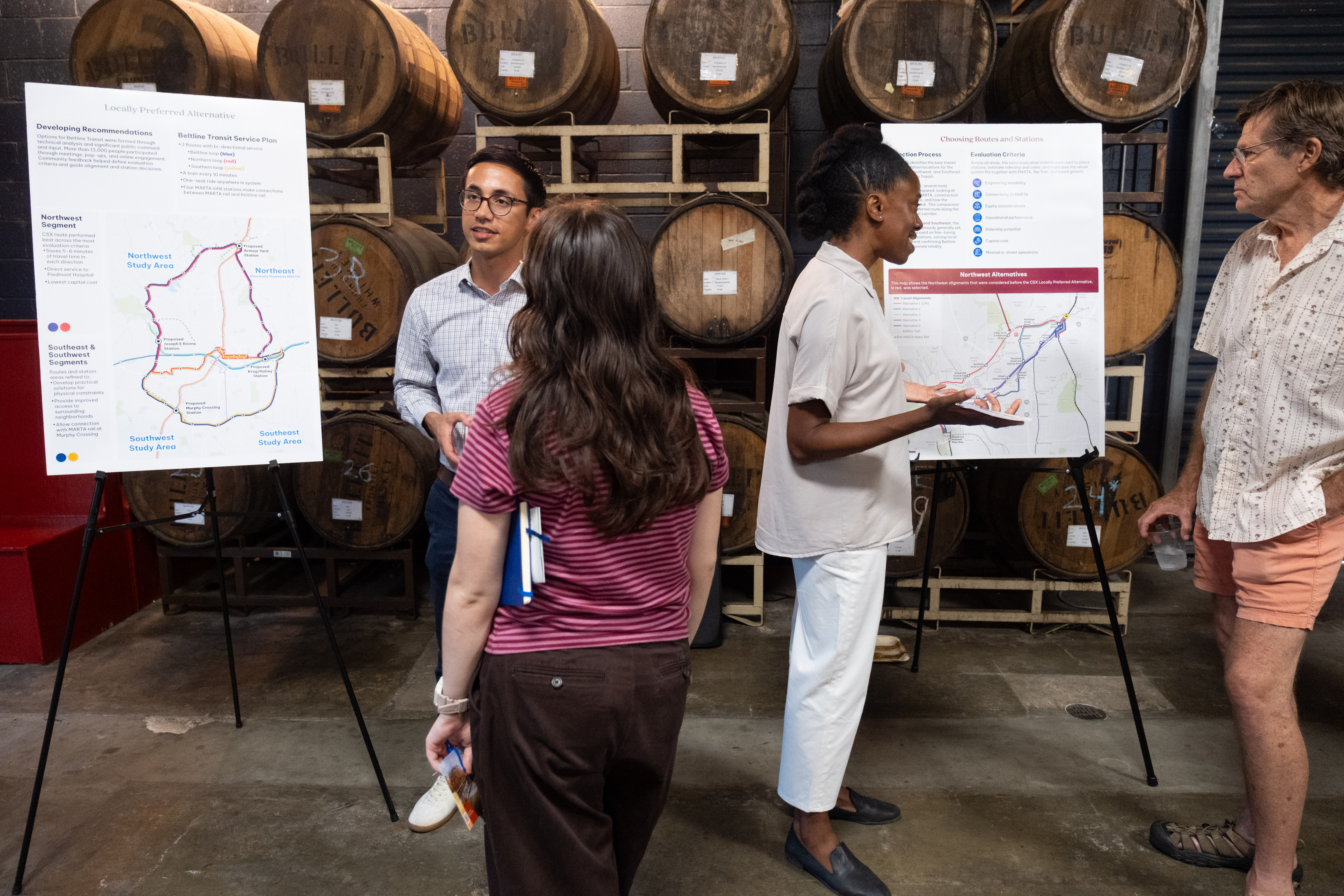
The public meeting concluded with an open house where those who attended on site were invited to ask questions and provide feedback. During one-on-one conversations with Beltline staff, community members inquired about the areas highlighted in the presentation and on the physical boards around the room. Experts provided additional background on the study's development and emphasized the importance of outlining a clear strategy and process, as well as an understanding of potential limitations. They welcomed all commentary, acknowledged the range of perspectives on the topic, and encouraged attendees to continue reaching out after the event.
Virtual attendees and residents who could not attend in person but would like to provide input or engage further about this study are invited to do so on our online portal, Konveio. The platform allows users to make comments directly on the same documents displayed at the event. Missed the meeting or want to take a closer look? Review the presentation and watch the recording to learn more.
Additional questions and comments can be sent to engage@atlbeltline.org. Feedback will be accepted through November 3, 2026.
Next steps
The Beltline Transit Study provides our long-term vision for a unified transit network making connections around the Beltline and to Downtown Atlanta. With a locally preferred alignment identified, the next steps include pursuing funding and advancing the additional planning and engineering needed to move the proposed light-rail system forward. As an implementation partner, Atlanta Beltline will work with the City of Atlanta and MARTA, whose funding and continued partnership will be necessary to advance the project.
Atlanta Beltline has also been tasked with advancing the concept for a potential Murphy Crossing MARTA infill station. Announced by Mayor Dickens in 2024 as part of a four-station infill initiative, the proposed heavy-rail station aligns with the Beltline Transit Study and could further connectivity in southwest Atlanta and around the Beltline.
Like the broader Beltline transit project, additional funding and coordination with MARTA and the City will be needed to advance this work. The next phase would explore the station’s feasibility and develop conceptual plans, elevations, renderings, and a planning-level capital cost estimate. This information would help inform future decisions about whether and how the station moves forward.
Stay tuned for more opportunities to engage on this phase later this Fall.
Subscribe to In The Loop, our monthly newsletter, for Beltline news, events, announcements and more.